Welding
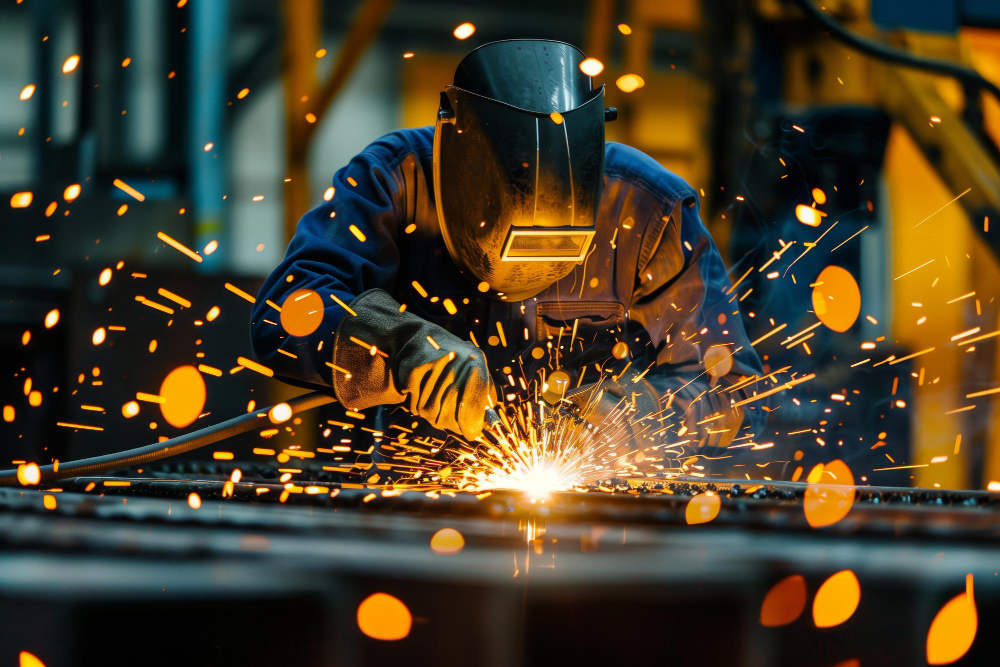
When choosing a welding service, material type, part thickness, joint geometry, intended application, and production volume should be evaluated together. A properly planned welding process ensures that metal parts are joined securely while maintaining dimensional accuracy and suitability for subsequent manufacturing stages.
Key evaluation criteria:
- Material type and thickness
- Joint configuration
- Weld seam requirements
- Part dimensions and tolerances
- Production volume
- Post-welding processing requirements
Avrasya Galvaniz plans welding processes for various metal fabrication projects according to the technical specifications of each part and production requirements, providing a controlled and reliable manufacturing approach.
What Does a Welding Service Include?
Welding services involve permanently joining metal parts at specified connection points. Depending on the intended application, corner joints, butt joints, frame structures, sheet metal parts, and various metal fabrication components can be joined through welding.
Before welding, part dimensions, contact surfaces, and the joining sequence are evaluated. Particularly in projects where multiple parts are assembled into a single structure, the welding sequence plays an important role in maintaining the final dimensions.
“A successful welding process requires not only securely joining the parts but also maintaining the geometry of the finished product.”
A key consideration in practice is that welding should not be evaluated independently from cutting and bending operations. Proper preparation of parts before production helps ensure a more controlled welding process.
For your welding requirements, share your technical drawings, material specifications, and production quantity with Avrasya Galvaniz to define the appropriate scope for your project.
Which Technical Criteria Are Evaluated in the Welding Process?
The physical characteristics of the parts should be evaluated in detail to determine the appropriate welding method and production plan. Material thickness, joint configuration, and the loads the finished part will be subjected to directly affect the process.
| Technical Criterion | Importance in Production |
|---|---|
| Material type | Affects the planning of the welding process |
| Part thickness | Plays a role in determining process parameters |
| Joint geometry | Determines the position and configuration of the weld seam |
| Part dimensions | Affects positioning and alignment |
| Tolerance | Helps maintain the final product dimensions |
| Production volume | Determines the requirements for repeatable production |
“Accurate technical evaluation before welding helps reduce part misalignment and unnecessary corrective work.”
In series production, maintaining consistent positioning when joining parts becomes particularly important. Therefore, part fixturing, alignment, and the welding sequence are just as important as the welding operation itself in maintaining production quality.
Why Is Welding Quality Important?
Welding quality plays a key role in the strength, geometry, and in-service performance of joined components. If weld continuity, part positioning, and joint configuration are not properly controlled, compatibility issues may occur during subsequent assembly operations.
In metal fabrication, maintaining post-welding geometry is particularly important for frames, enclosures, bodies, profiles, and sheet metal structures. Controlling heat input and the welding sequence helps minimize distortion and maintain the intended part geometry.
“Welding quality should be evaluated not only by the appearance of the joint but also by the dimensional integrity of the part and its suitability for the intended application.”
An effective production approach focuses on strengthening pre-welding planning rather than relying on corrective work after welding. More consistent results can be achieved when technical drawings, joint locations, and assembly requirements are clearly defined from the outset.
How Does the Welding Order Process Work?
Providing clear and complete technical information for welding orders helps ensure that the production plan is prepared accurately. Part dimensions, material thickness, joint locations, and production quantity are among the key details required.
The general workflow consists of the following steps:
- Submission of technical drawings and project specifications
- Evaluation of materials and part dimensions
- Identification of joint locations
- Planning of the welding sequence
- Execution of welding operations
- Inspection of dimensions and welded joints
- Preparation of parts for subsequent manufacturing stages
Avrasya Galvaniz evaluates welding requirements together with production specifications to establish the appropriate sequence of operations for each project.
Production Control in Welding Services
When selecting a welding service, technical communication, part preparation, dimensional control, and production consistency should be evaluated together. Particularly for projects requiring recurring production, consistently manufactured parts help improve efficiency during subsequent assembly operations.
Coordinating cutting, bending, and welding processes helps reduce unnecessary rework throughout the metal fabrication process. Considering the part’s intended application from the beginning also makes it easier to develop an appropriate welding plan.
Avrasya Galvaniz provides a project-focused approach to welding services, taking requirements from technical drawings through production planning into account. Share your material specifications, dimensions, production quantity, and technical drawings to develop a solution tailored to your welding and manufacturing requirements.