Surface Preparation for Galvanizing
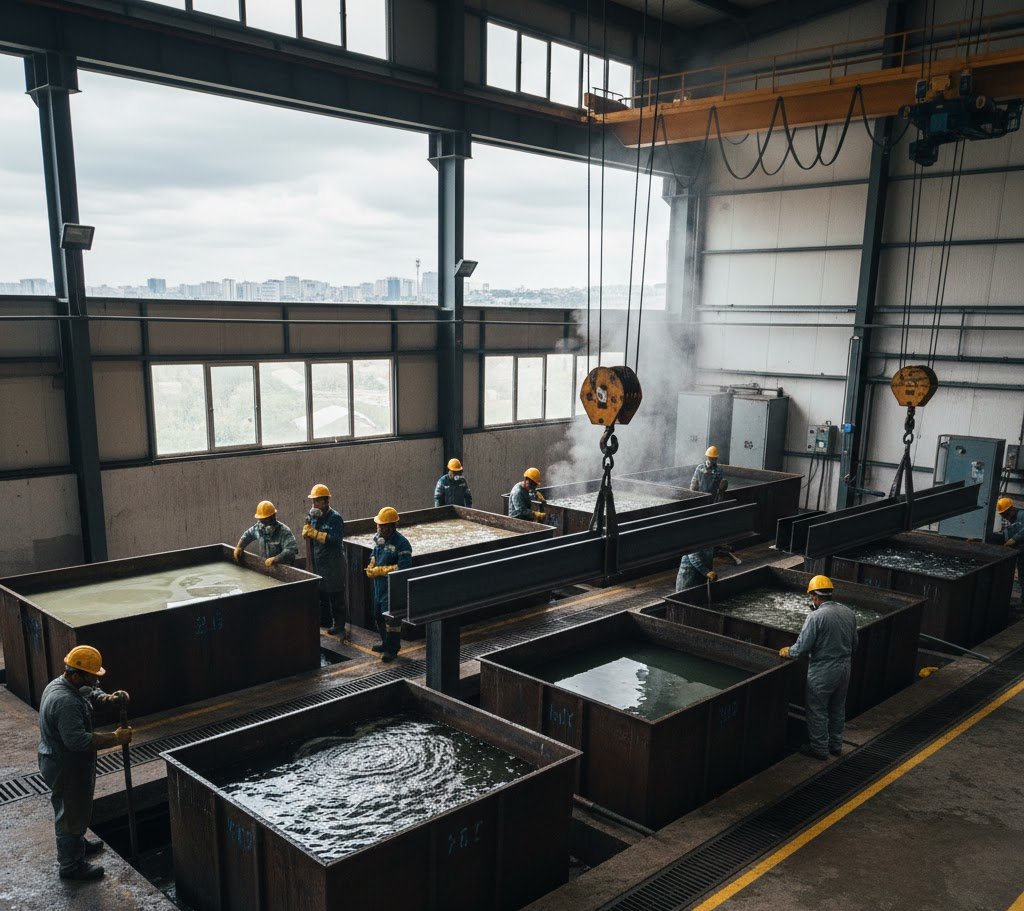
Surface preparation for galvanizing is one of the most critical stages in achieving reliable, long-term corrosion protection for steel. Oil, grease, rust, mill scale, paint, welding residues, and other contaminants can prevent molten zinc from reacting properly with the steel surface.
Inadequate surface preparation can result in problems such as:
- Uncoated areas
- Irregular coating formation
- Surface contamination
- Local coating defects
- Reduced corrosion protection
For this reason, professional galvanizing facilities treat surface preparation as an essential part of process control rather than simply a cleaning operation.
How Does Surface Quality Affect Zinc Coating Formation?
During hot-dip galvanizing, zinc reacts metallurgically with properly prepared steel and forms zinc-iron alloy layers.
For this reaction to occur effectively, the steel surface must be chemically clean and suitable for galvanizing.
Surface contaminants can:
- Prevent zinc from wetting the steel
- Create uncoated areas
- Interfere with coating formation
- Cause localized surface defects
“Molten zinc cannot compensate for inadequate surface preparation.”
However, it is important to distinguish coating formation from conventional paint adhesion. Hot-dip galvanizing creates a metallurgical reaction with steel rather than relying only on mechanical adhesion.
Main Surface Preparation Stages Before Galvanizing
A typical surface preparation process for batch hot-dip galvanizing includes:
- Initial inspection
- Degreasing
- Rinsing
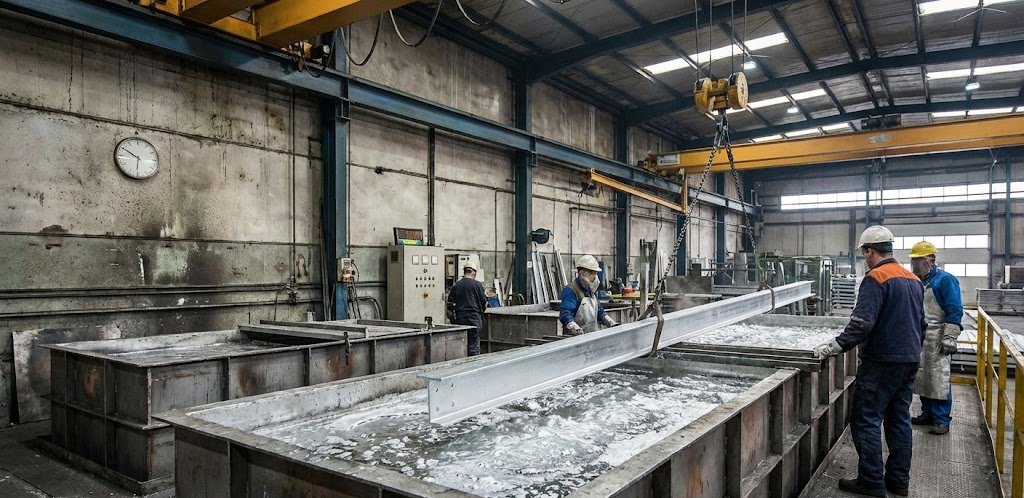
- Pickling
- Rinsing
- Fluxing
- Drying or preheating where used
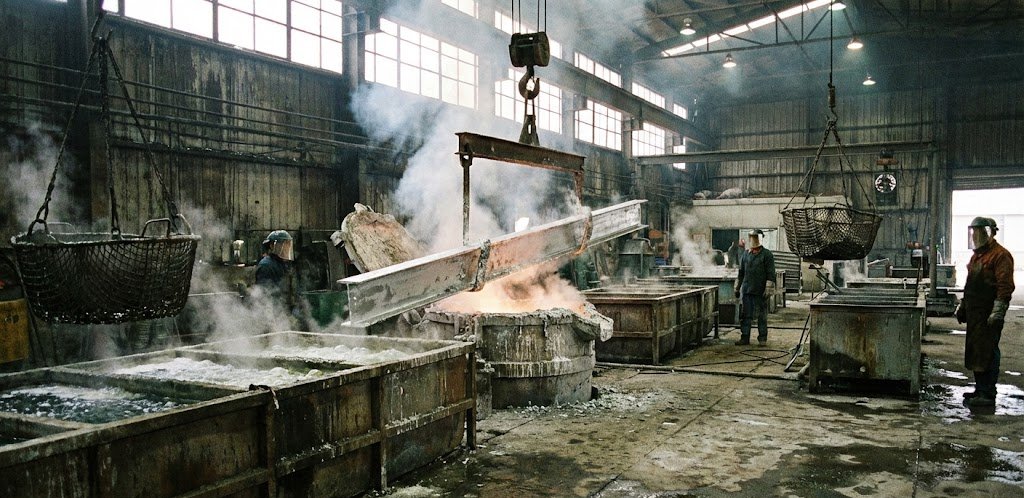
- Immersion in molten zinc
The exact operating parameters vary according to plant design, chemical systems, component condition, and process requirements.
Degreasing
Degreasing removes oil, grease, machining fluids, and suitable organic contaminants from the steel surface.
Industrial galvanizing plants may use alkaline, acidic, or specialized cleaning systems.
Process parameters such as temperature and treatment time depend on:
- Cleaning chemistry
- Contamination level
- Component geometry
- Bath concentration
- Plant operating procedure
A universal temperature or treatment time should therefore not be specified for every galvanizing facility.
If grease or oil remains on the steel, subsequent pickling may not clean the underlying surface effectively.
Rinsing
After degreasing, rinsing helps prevent cleaning chemicals and contaminants from being carried into subsequent process baths.
Important considerations may include:
- Water quality
- Chemical carryover
- Contamination levels
- Water consumption
- Rinsing efficiency
Some facilities use multi-stage or counter-current rinsing systems to improve water efficiency and process control.
Pickling
Pickling removes rust and mill scale from the steel surface.
Hydrochloric acid is commonly used in many galvanizing plants, although sulfuric acid and other process arrangements may also be used.
The appropriate:
- Acid concentration
- Temperature
- Treatment time
- Inhibitor use
depends on the steel condition and plant chemistry.
Insufficient pickling may leave oxides on the surface, while excessive exposure can unnecessarily attack the base steel.
Final Rinsing
After pickling, rinsing reduces acid carryover into the flux bath.
This helps:
- Maintain flux chemistry
- Reduce contamination
- Improve process stability
- Support bath management
Deionized water is not universally required for batch hot-dip galvanizing. Water quality should instead be managed according to the plant’s process requirements.
Fluxing
Fluxing is an important preparation stage before immersion in molten zinc.
In dry hot-dip galvanizing processes, zinc ammonium chloride-based fluxes are commonly used.
Flux performs several functions:
- Reduces oxidation of the cleaned steel before immersion
- Helps molten zinc wet the steel surface
- Supports the zinc-steel metallurgical reaction
Flux parameters can include:
- Concentration
- Density
- Temperature
- pH
- Iron contamination
There is no single Baumé value that applies universally to every flux chemistry and galvanizing facility.
Drying and Preheating
Some galvanizing facilities dry or preheat fluxed components before immersion.
This can help:
- Remove moisture
- Dry the flux layer
- Reduce the risk of violent moisture-related reactions with molten zinc
- Improve production efficiency
The appropriate drying temperature and duration depend on plant design, component dimensions, and operating procedures.
For large or complex fabricated components, complete drainage and moisture control are particularly important.
When Is Mechanical Surface Preparation Required?
Standard chemical pretreatment cannot remove every type of surface contamination.
Mechanical preparation may be necessary for:
- Paint
- Welding slag
- Certain marking materials
- Heavy contamination
- Sand or casting residues
- Surface deposits resistant to chemical cleaning
Common mechanical methods include:
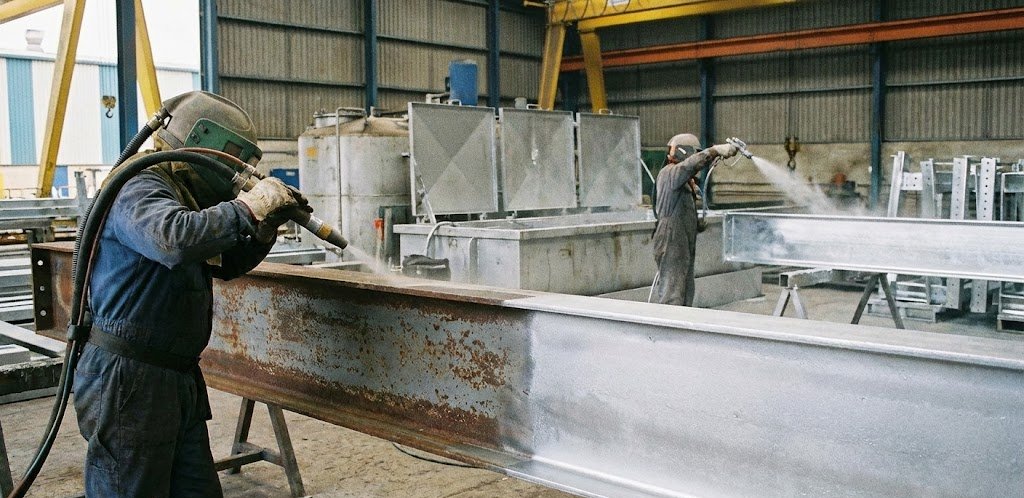
- Abrasive blasting
- Grinding
- Wire brushing
- Local mechanical cleaning
These operations should generally be completed before the component enters the galvanizing line.
Abrasive Blasting
Abrasive blasting can remove coatings and contaminants that standard chemical pretreatment cannot effectively eliminate.
However, blasting is not automatically required for all steel that will be hot-dip galvanized.
The surface preparation grade should be selected according to the actual process and specification. ISO 8501-1 is widely used for visual assessment of blast-cleaned steel, but specifying Sa 2½ as a universal requirement for all hot-dip galvanizing projects would be inappropriate.
Excessively rough surfaces can also influence coating growth and zinc consumption.
Shot Blasting and Shot Peening
Shot blasting and shot peening are different processes.
Shot blasting is primarily used for surface cleaning and preparation.
Shot peening is a controlled mechanical treatment used to introduce compressive residual stresses and improve fatigue performance in certain components.
Shot peening should not be treated as a routine surface preparation step for hot-dip galvanizing unless specifically required by the component design or manufacturing process.
Factors Affecting Galvanized Coating Quality
Several factors influence the final coating:
| Factor | Main Influence |
|---|---|
| Surface cleanliness | Enables zinc-steel reaction |
| Steel chemistry | Influences coating growth and appearance |
| Pickling | Removes rust and mill scale |
| Fluxing | Supports wetting and limits oxidation |
| Component design | Controls venting and drainage |
| Zinc bath conditions | Influence coating formation |
| Withdrawal and drainage | Affect free-zinc distribution |
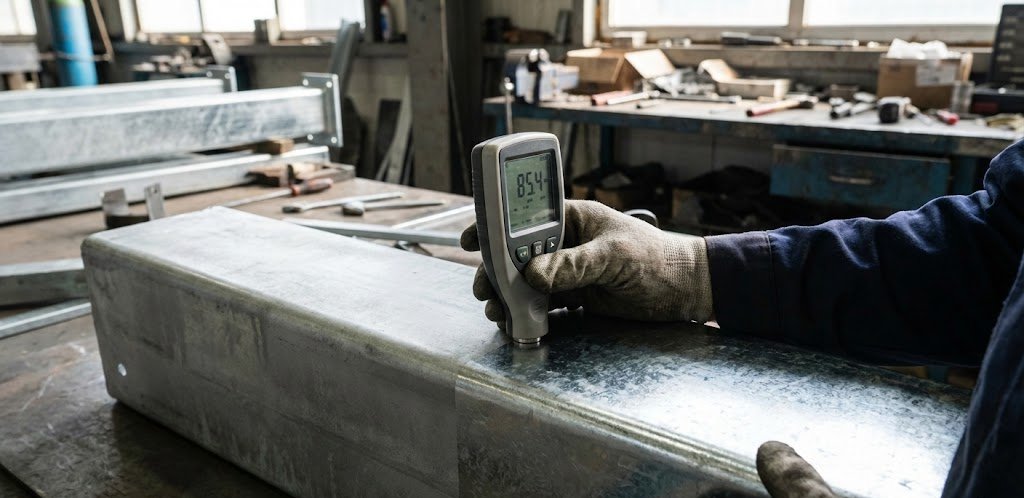
| Inspection | Verifies compliance |
Surface roughness can influence coating formation, but there is no universal target Ra value for all hot-dip galvanized fabricated steel.
Common Surface Preparation Problems
Typical issues include:
Incomplete degreasing: May leave areas that cannot be properly pickled or galvanized.
Insufficient pickling: Can leave rust or mill scale and produce uncoated areas.
Paint or welding contamination: Standard chemical pretreatment may not remove these materials.
Poor flux control: Can affect wetting and process consistency.
Trapped moisture: Can create serious safety risks when components enter molten zinc.
Inadequate venting and drainage: Can prevent process liquids and zinc from flowing safely through hollow components.
Surface Preparation Checklist
Before galvanizing, check that:
- Oil and grease contamination has been addressed.
- Paint and incompatible marking materials have been removed.
- Welding slag and residues have been cleaned.
- Hollow components have suitable vent and drain holes.
- Enclosed cavities have been eliminated or correctly vented.
- Fabrication is substantially complete.
- Critical threads and tolerances have been considered.
- Component geometry allows effective zinc drainage.
- Technical drawings have been reviewed where necessary.
→ Clean steel allows the zinc reaction to occur; good design allows the zinc to reach and leave the surface safely.
Quality Control After Surface Preparation
Surface preparation is normally evaluated as part of the overall galvanizing process rather than through one universal laboratory test.
The most practical confirmation occurs after galvanizing, when the finished component is inspected for coating continuity and compliance with the applicable specification.
For batch hot-dip galvanized fabricated iron and steel articles, EN ISO 1461 is commonly used as a reference for coating requirements and test methods.
Surface Preparation at Avrasya Galvaniz
Avrasya Galvaniz provides hot-dip galvanizing solutions for fabricated steel and industrial projects.
Project-specific preparation requirements can be evaluated according to:
- Incoming surface condition
- Steel characteristics
- Component dimensions
- Product geometry
- Fabrication details
- Venting and drainage
- Applicable galvanizing standard
- Inspection requirements
- Production quantities
For unusual, painted, heavily contaminated, hollow, or complex components, technical evaluation before production can help determine whether additional preparation is required.
Why Surface Preparation Matters
Surface preparation forms the foundation of a successful hot-dip galvanizing process. Proper degreasing, pickling, rinsing, fluxing, moisture control, and component design allow molten zinc to react correctly with steel.
The objective is not simply to make the surface visually clean. It is to create the metallurgically suitable condition required for zinc coating formation.
For project-specific hot-dip galvanizing requirements, Avrasya Galvaniz can evaluate technical drawings, component dimensions, surface condition, steel characteristics, quantities, and coating specifications to determine an appropriate preparation and galvanizing process.