Stages of the Galvanizing Process
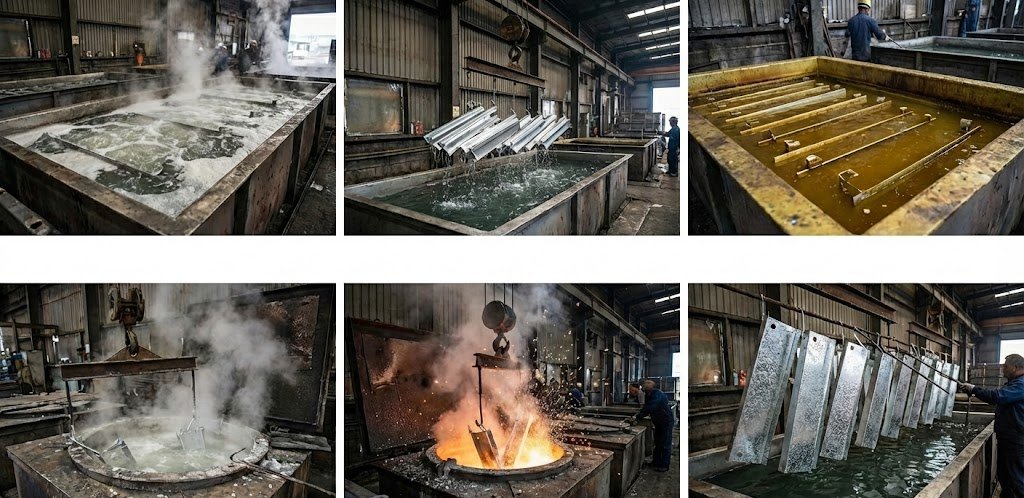
Galvanizing is a multi-stage process used to protect steel surfaces with zinc and extend their service life. In industrial applications, consistent results depend on controlled surface preparation, appropriate component design, zinc bath management, and post-galvanizing inspection.
For batch hot-dip galvanizing, the objective is to create metallurgically bonded zinc-iron layers on a properly prepared steel surface. The finished zinc coating provides both barrier and sacrificial corrosion protection.
Why Is Galvanizing Applied?
Galvanizing is primarily applied to protect steel against atmospheric corrosion and environmental exposure. Moisture, oxygen, salts, pollutants, and certain chemicals can accelerate corrosion and gradually reduce the integrity of unprotected steel.
The zinc coating provides two primary protection mechanisms:
Barrier protection: Zinc separates the steel from direct environmental exposure.
Sacrificial protection: Zinc is more electrochemically active than steel, so it can corrode preferentially around small exposed areas and help protect the underlying steel.
As zinc weathers naturally, corrosion products can also form on the surface and contribute to its barrier properties.
The service life of galvanized steel is not a fixed number. It depends on coating thickness, environmental corrosivity, product design, exposure conditions, and maintenance.
What Are the Stages of Hot-Dip Galvanizing?
A typical batch hot-dip galvanizing process consists of:
- Initial inspection and design review
- Degreasing
- Rinsing
- Pickling
- Rinsing
- Fluxing
- Drying or preheating where used
- Immersion in molten zinc
- Withdrawal and drainage
- Cooling
- Finishing and inspection
- Optional post-treatment where specified
Each stage influences the quality, safety, and efficiency of the galvanizing process.
Importance of Surface Preparation
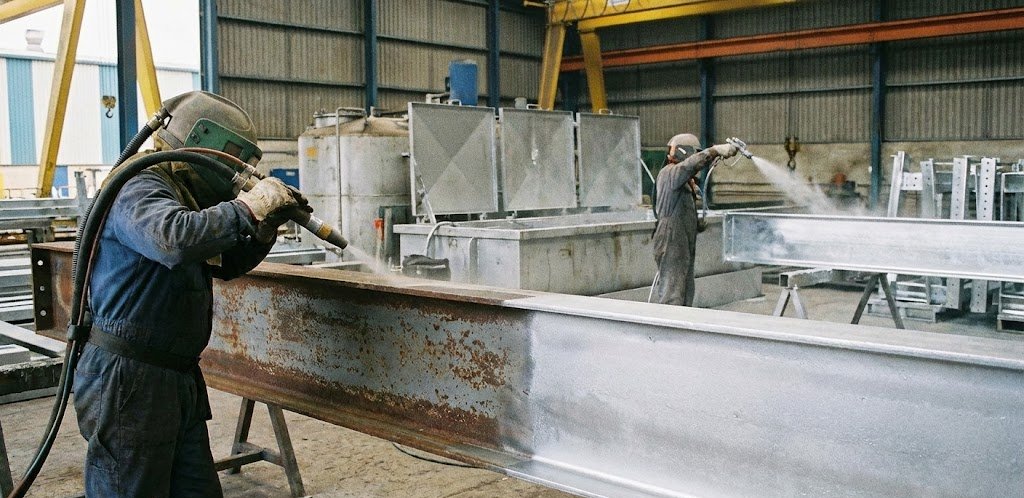
Surface preparation is one of the most critical parts of hot-dip galvanizing because zinc cannot react properly with steel if contaminants remain on the surface.
Paint, oil, grease, rust, mill scale, welding residues, and other contaminants must be addressed using suitable preparation methods.
It is not accurate to assign a universal percentage of galvanizing defects to surface preparation without a verified source. However, inadequate preparation is a well-established cause of uncoated or poorly galvanized areas.
Degreasing
Degreasing removes oil, grease, machining fluids, and suitable organic contaminants from the steel surface.
Depending on the plant process, alkaline, acidic, or other industrial cleaning systems may be used.
The exact temperature, concentration, and treatment time depend on:
- Cleaning chemistry
- Contamination level
- Component geometry
- Plant operating procedure
There is no single universal degreasing temperature suitable for every galvanizing facility.
Rinsing
Rinsing helps reduce the transfer of chemicals and contaminants between pretreatment stages.
Industrial galvanizing plants may use single-stage or multi-stage rinsing systems depending on plant design and water-management strategy.
Process controls can include monitoring of solution chemistry, contamination, water use, and carryover.
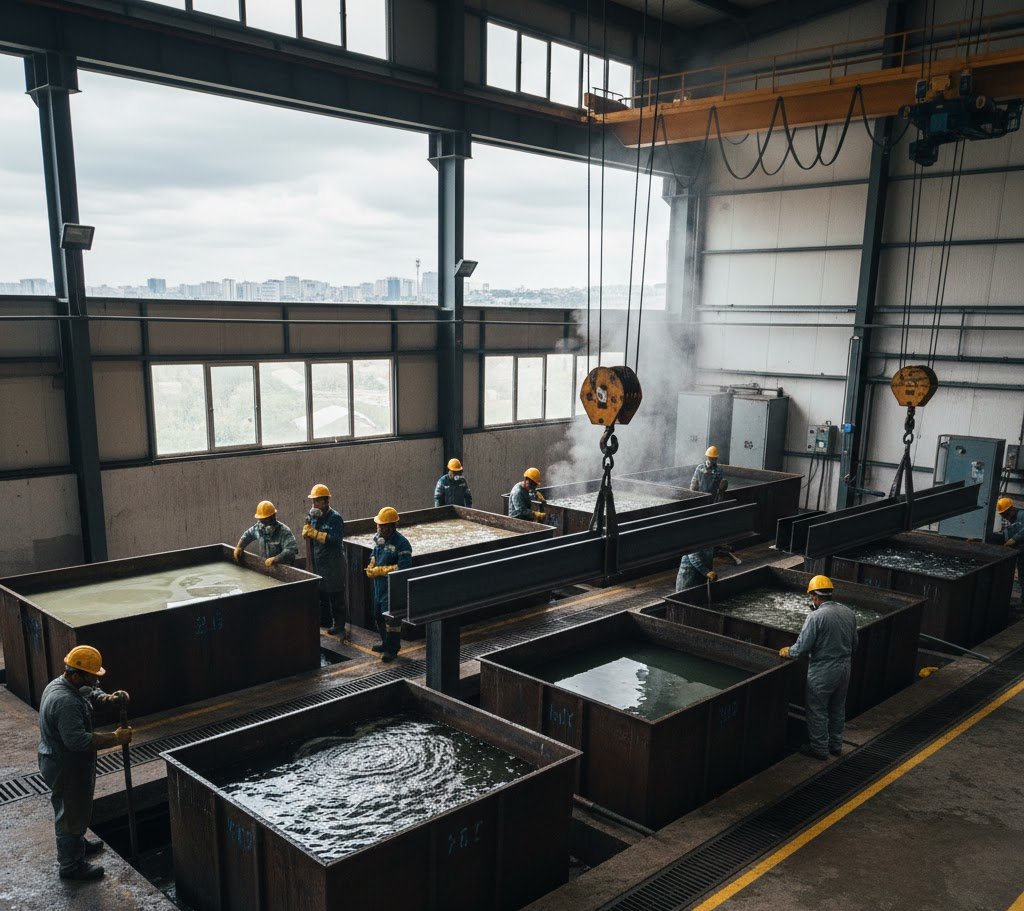
Pickling
Pickling removes rust and mill scale from the steel surface.
Hydrochloric acid is commonly used in many hot-dip galvanizing facilities, although process chemistry varies between plants.
Pickling conditions must be controlled because insufficient treatment may leave oxides on the surface, while excessive exposure can unnecessarily attack the base steel.
For high-strength steels, acid pretreatment also requires careful consideration because of potential hydrogen-related risks.
Second Rinsing Stage
After pickling, the steel is typically rinsed to reduce acid carryover into subsequent process stages.
Efficient rinsing helps:
- Maintain flux chemistry
- Reduce contamination
- Improve process stability
- Support chemical management
Some facilities use counter-current rinsing and other water-efficiency strategies.
Fluxing
Fluxing prepares the cleaned steel surface for immersion in molten zinc.
A zinc ammonium chloride-based flux is commonly used in dry hot-dip galvanizing processes. Its main functions are to reduce oxidation before immersion and support wetting and reaction between molten zinc and steel.
Flux bath parameters may include:
- Concentration
- Temperature
- pH
- Iron contamination
- Density
The appropriate operating range depends on the specific flux chemistry and plant process.
Dry and Wet Galvanizing Processes
Hot-dip galvanizing facilities may use different fluxing arrangements.
In a dry galvanizing process, the component is generally fluxed and dried before entering the zinc bath.
In a wet galvanizing process, a flux layer may be maintained on part of the zinc bath surface.
Neither method should automatically be described as universally superior. The appropriate system depends on plant design, product requirements, and process control.
Drying and Preheating
Some dry galvanizing facilities use a drying or preheating stage before immersion.
The objectives can include:
- Removing moisture
- Drying the flux layer
- Reducing thermal shock
- Supporting safer immersion
- Improving process efficiency
Exact drying temperatures and times vary according to the facility and component. They should not be treated as universal fixed values.
Immersion in Molten Zinc
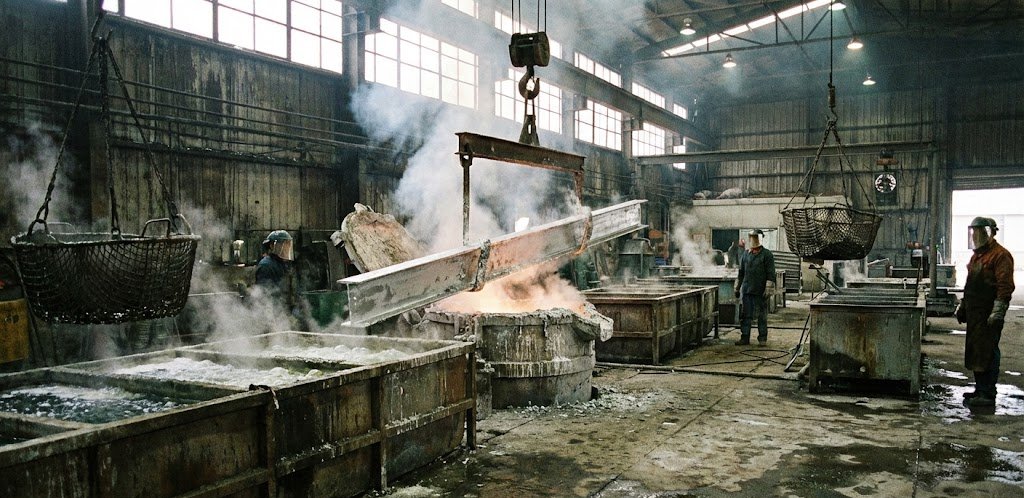
Hot-dip galvanizing is typically carried out in molten zinc at approximately 450°C.
When properly prepared steel is immersed, zinc reacts with iron to form metallurgically bonded zinc-iron alloy layers.
The coating develops according to factors including:
- Steel chemistry
- Material thickness
- Surface condition
- Zinc bath conditions
- Immersion time
- Component geometry
The objective is not to force zinc to “penetrate” the steel but to create a controlled metallurgical reaction at the steel-zinc interface.
Structure of the Zinc-Iron Coating
A typical hot-dip galvanized coating can contain several zinc-iron alloy layers, commonly described as gamma, delta, and zeta phases, with an outer eta layer consisting primarily of zinc.
The exact structure and relative thickness of these layers depend strongly on steel chemistry and process conditions.
Silicon and phosphorus in the steel are particularly important because they can influence coating growth.
Detailed phase compositions are metallurgical reference values and should not normally be used as routine production acceptance criteria unless required by a specific technical investigation.
Withdrawal and Removal of Excess Zinc
When the component is removed from the zinc bath, molten zinc drains from its surface.
Drainage depends on:
- Component orientation
- Withdrawal speed
- Hole size
- Venting and drainage design
- Surface geometry
- Zinc viscosity
For fabricated structural components, proper design is one of the most effective ways to prevent excessive zinc accumulation.
Centrifuging is commonly used for suitable small components such as fasteners. Air knives are more commonly associated with continuous sheet galvanizing and should not be presented as a universal method for batch structural galvanizing.
Cooling
After withdrawal, the zinc coating solidifies as the component cools.
Cooling methods vary between facilities and products. Components may be air-cooled or quenched where the process and specification allow.
Cooling can influence appearance and subsequent handling, but it should be managed according to the material, component geometry, and project requirements.
Passivation and Post-Treatment
Post-treatment may be used where protection against wet-storage staining is required.
Freshly galvanized zinc can develop white corrosion products if moisture is trapped between closely stacked surfaces without adequate ventilation.
Depending on project requirements, protection may involve:
- Passivation
- Temporary protective treatments
- Appropriate storage
- Dry transportation
- Good ventilation between components
Modern post-treatment systems may use chromium-free chemistries depending on regulatory and technical requirements.
What Affects Galvanized Coating Thickness?
Hot-dip galvanized coating thickness is influenced by several variables.
| Parameter | Main Influence |
|---|---|
| Steel chemistry | Controls zinc-iron reaction and coating growth |
| Material thickness | Influences heating and standard coating category |
| Surface condition | Affects reaction and coating formation |
| Zinc bath conditions | Influence metallurgical reaction |
| Immersion time | Can influence coating development |
| Component geometry | Affects drainage and local zinc accumulation |
| Withdrawal conditions | Influence free-zinc distribution |
Steel chemistry, particularly silicon and phosphorus content, is often one of the most influential variables.
Effect of Steel Chemistry
Silicon and phosphorus can significantly affect the reaction between steel and molten zinc.
Rather than relying on a single universal silicon range, the steel chemistry should be reviewed against relevant galvanizing guidance because the relationship between composition and coating growth is not linear across all steels.
Material certificates can therefore provide useful information before galvanizing important structural components.
Role of Zinc Bath Parameters
Hot-dip galvanizing baths are commonly operated at approximately 450°C, but the exact controlled operating range depends on the plant process.
Bath temperature is only one variable. Zinc chemistry, steel chemistry, immersion conditions, component mass, and drainage also influence the finished coating.
Effect of Immersion Time
Immersion time is determined partly by the time required for the component to reach suitable thermal conditions and complete the galvanizing reaction.
Large or thick components may require longer immersion than lightweight components.
However, coating thickness does not increase at a simple fixed rate with immersion time. Steel chemistry can have a stronger influence.
How Is Quality Control Performed After Galvanizing?
Post-galvanizing quality control verifies whether the coating meets the applicable specification.
For batch hot-dip galvanized fabricated iron and steel articles, EN ISO 1461 is a commonly used reference. ASTM A123/A123M may apply to projects specified under ASTM requirements.
Quality control commonly includes:
Visual Inspection
The surface is examined for coating continuity and conditions that could interfere with intended use.
Color differences or matte areas are not automatically defects.
Coating Thickness Measurement
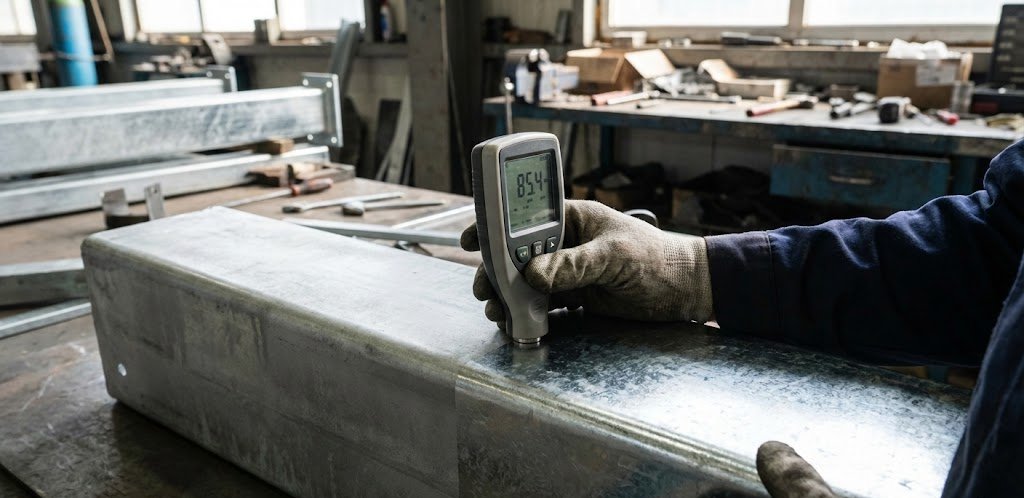
Magnetic coating thickness gauges are widely used for non-destructive measurement of zinc coatings on steel.
Measurements should be taken at representative locations according to the sampling requirements of the applicable standard.
There is no universal rule requiring exactly five measurement areas for every product, and there is no single 45–85 µm acceptance range that applies to all steel products.
Adhesion Evaluation
Hot-dip galvanized coatings are metallurgically bonded to steel. Routine bend, notch, thermal shock, or pull-off testing is not automatically required for every batch.
If a project requires a specific adhesion or mechanical test, the method defined by the applicable standard or specification should be used.
Dimensional Inspection
Threads, holes, connection surfaces, flatness, and other critical dimensions may be checked where required by the project.
Galvanizing Solutions from Avrasya Galvaniz
Avrasya Galvaniz provides hot-dip galvanizing solutions for fabricated steel and industrial projects.
Project evaluation may include:
- Technical drawings
- Steel characteristics
- Component dimensions
- Venting and drainage requirements
- Surface condition
- Applicable coating standard
- Inspection requirements
- Production quantities
- Delivery planning
Process monitoring and quality inspection should be selected according to the actual product and project requirements rather than relying on unsupported fixed parameters.
How Can the Service Life of Galvanized Coating Be Extended?
The service life of galvanized steel depends primarily on zinc coating thickness and the rate at which the environment consumes that zinc.
To support longer service life:
- Select the coating specification according to environmental corrosivity.
- Avoid designs that retain water and contaminants.
- Minimize cutting and welding after galvanizing.
- Repair damaged coating areas using an appropriate method.
- Prevent wet-storage staining during transportation and storage.
- Consider a duplex paint-over-galvanizing system for demanding environments.
- Inspect critical structures periodically.
The most effective approach is to consider corrosion protection during the design stage rather than after fabrication is complete.
Hot-dip galvanizing is a controlled metallurgical process in which surface preparation, component design, steel chemistry, zinc bath conditions, drainage, cooling, and quality inspection all influence the final result.
When these stages are coordinated correctly, galvanized steel can provide long-term corrosion protection with relatively low maintenance requirements. For project-specific galvanizing requirements, Avrasya Galvaniz can evaluate technical drawings, component dimensions, quantities, coating specifications, and operating conditions to determine an appropriate process.