Quality Control Steps After Galvanizing

Galvanizing is the process of applying a zinc coating to metal surfaces to protect them against corrosion. Particularly for steel products, hot-dip galvanizing can provide long-term corrosion protection and durability. However, the process does not end when the product leaves the zinc bath. Post-galvanizing quality control is essential for verifying that the coating meets the applicable project specifications and standards.
Quality control may include visual inspection, coating thickness measurement, dimensional checks, assessment of uncoated areas, and other tests where required by the relevant standard or contract.
Purpose of Quality Control After Galvanizing
The main purpose of post-galvanizing quality control is to verify that the finished coating complies with the specified requirements.
Important criteria may include:
- Coating continuity
- Coating thickness
- Surface condition
- Absence of unacceptable defects
- Dimensional suitability
- Condition of threads and connection areas
- Compliance with the applicable galvanizing standard
“Quality control does not create coating quality; it verifies whether the galvanizing process achieved the specified requirements.”
Inspection also helps identify issues before components are transported to the construction site or incorporated into a larger assembly.
Why Is Post-Galvanizing Quality Control Important?
A properly specified galvanized coating should provide reliable corrosion protection throughout its intended service life. If important defects or non-conformities are overlooked, premature corrosion, assembly difficulties, or additional repair costs may occur.
Quality control can identify issues such as:
- Uncoated areas
- Excessive zinc accumulation
- Sharp projections
- Drainage-related defects
- Distortion
- Damaged threads
- Coating thickness outside specified requirements
- Areas requiring repair
Not every variation in the appearance of galvanized steel is a defect. Bright, matte, or locally different surface appearances may result from steel chemistry and cooling conditions without reducing corrosion protection.
Visual Inspection
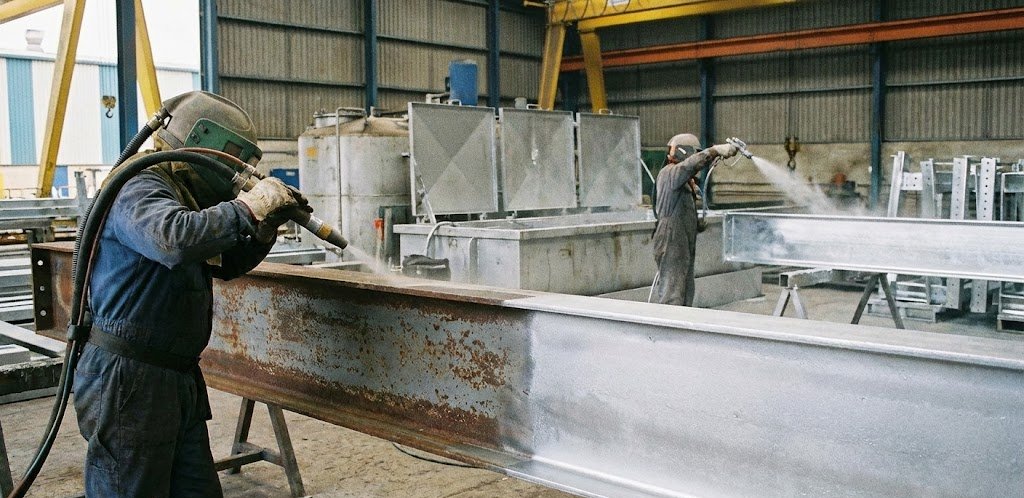
Visual inspection is generally one of the first quality control steps after galvanizing. Accessible surfaces are examined for coating continuity and unacceptable surface conditions.
Inspectors may check for:
- Bare or uncoated areas
- Excess zinc accumulations
- Sharp zinc projections
- Flux residues
- Areas that may interfere with assembly
- Damage caused during handling
- Drainage-related problems
Visual inspection should focus on functional and standard-based acceptance criteria rather than requiring a perfectly uniform decorative appearance.
Coating Thickness Measurement
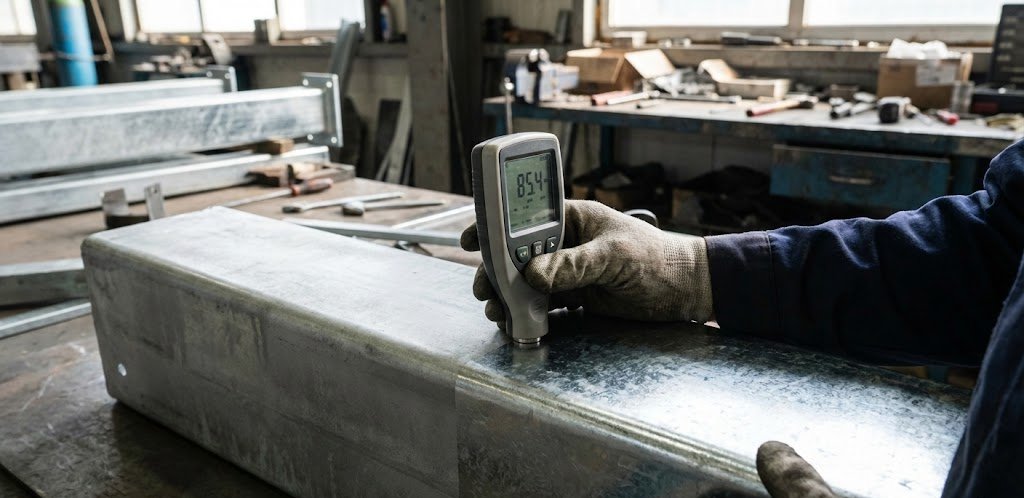
Coating thickness is one of the most important measurable characteristics of a galvanized coating. For zinc coatings on steel, portable magnetic coating thickness gauges are commonly used for non-destructive measurements.
Measurements should be taken at representative locations according to the sampling and acceptance requirements of the applicable standard.
For batch hot-dip galvanized fabricated iron and steel articles, EN ISO 1461 is a commonly used reference. Required minimum coating thickness varies according to the type and thickness of the steel article.
A single measurement is generally not sufficient to evaluate an entire component or inspection lot.
Coating Adhesion
Hot-dip galvanized coatings form through a metallurgical reaction between zinc and steel. For this reason, routine adhesion testing is not necessarily required for every batch of hot-dip galvanized products.
Where adhesion or mechanical performance testing is specifically required by a product standard, customer specification, or technical agreement, the appropriate standardized method should be used.
Tests such as scratch, impact, or pull-off testing should not be applied indiscriminately because methods designed for paint or other coating systems may not be appropriate for hot-dip galvanized coatings.
Corrosion Resistance Testing
Salt spray testing is widely used for certain coating systems, particularly electroplated coatings, conversion coatings, and painted systems. However, it is not generally the primary routine acceptance test for batch hot-dip galvanized structural steel.
For hot-dip galvanized steel, long-term atmospheric performance is strongly related to:
- Zinc coating thickness
- Environmental corrosivity
- Exposure conditions
- Wetting and drying cycles
- Salt and pollutant exposure
- Product design
If accelerated corrosion testing is required by a specific product standard or customer specification, the applicable test method should be followed.
Dimensional Inspection
Galvanizing can affect certain dimensions, particularly threads, close-fitting connections, holes, and precision assemblies. Thermal exposure may also contribute to distortion in some fabricated components if the design or fabrication is susceptible.
Post-galvanizing dimensional inspection may therefore include:
- Hole dimensions
- Thread condition
- Flatness
- Straightness
- Connection interfaces
- Critical assembly dimensions
For precision components, galvanizing requirements should ideally be considered during the design stage rather than corrected after coating.
Coating Distribution and Uniformity
A galvanized coating does not need to have exactly the same thickness at every point to provide acceptable protection. Local thickness can vary because of steel chemistry, component geometry, surface condition, withdrawal angle, and drainage behavior.
Quality control should therefore assess coating thickness according to the sampling rules and minimum requirements of the applicable standard rather than expecting identical measurements across the entire surface.
The critical point is compliance with the specified acceptance criteria.
Quality Standards and Documentation
Several standards may be relevant to galvanizing and corrosion protection:
EN ISO 1461: Specifies general properties and test methods for hot-dip galvanized coatings on fabricated iron and steel articles.
EN ISO 14713 series: Provides guidance and recommendations concerning zinc coatings for corrosion protection of iron and steel structures.
ASTM A123/A123M: Covers zinc coatings on iron and steel products under the relevant ASTM requirements.
The correct standard should be selected according to the product, coating process, market, and project specification.
Quality documentation may include inspection reports, coating thickness records, material documentation, and other project-specific records where required.
Quality-Focused Galvanizing with Avrasya Galvaniz
Avrasya Galvaniz provides hot-dip galvanizing solutions for fabricated steel and industrial projects. Quality control requirements can be evaluated according to the applicable standard and project specification.
Depending on project requirements, the inspection process may include:
- Visual inspection
- Coating thickness measurement
- Assessment of surface condition
- Inspection of critical connection areas
- Dimensional checks where specified
- Documentation according to project requirements
Providing technical drawings and quality requirements before production helps align the galvanizing and inspection processes with the project.
Quality Control Checklist After Galvanizing
Before accepting galvanized components, check whether:
- The applicable coating standard has been identified.
- Accessible surfaces have been visually inspected.
- Coating thickness has been measured at representative locations.
- Bare areas and unacceptable zinc accumulations have been evaluated.
- Threads, holes, and connection points are suitable for assembly.
- Any specified dimensional checks have been completed.
- Required repairs comply with the applicable standard.
- Inspection documentation has been completed where required.
Quality Inspection Supports Long-Term Protection
Post-galvanizing quality control is an important stage for confirming that galvanized steel products meet specified coating and project requirements. Visual inspection, coating thickness measurement, dimensional verification, and appropriate documentation provide a practical basis for acceptance.
The exact inspection program should be determined by the applicable galvanizing standard, product specification, and project requirements rather than applying every possible laboratory test to every galvanized component.
For project-specific hot-dip galvanizing and quality control requirements, Avrasya Galvaniz can evaluate technical drawings, component dimensions, coating specifications, quantities, and required inspection documentation.