Galvanized Coating Renewal
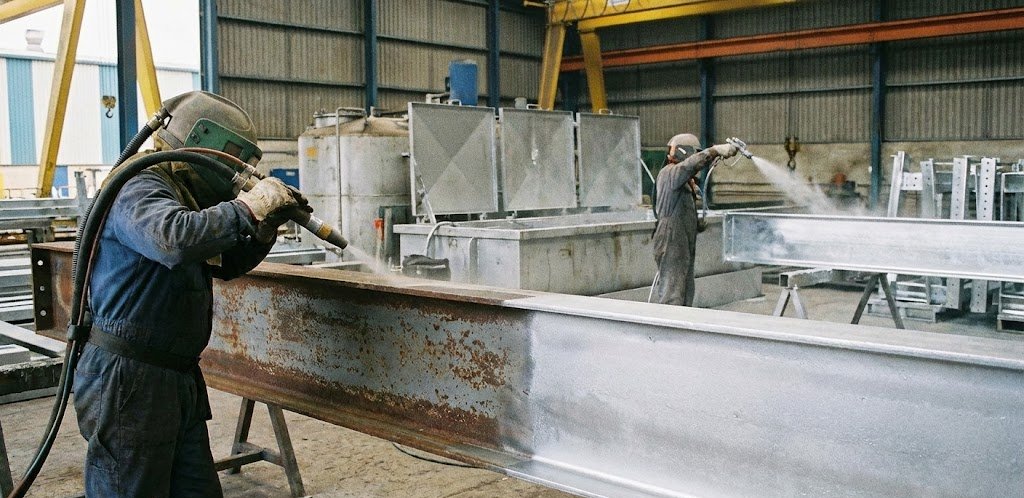
Galvanized coating renewal is the process of restoring corrosion protection when an existing zinc coating has been damaged, locally removed, or substantially consumed during service. Depending on the condition of the component, renewal may involve localized repair, a zinc-rich coating, thermal spraying, or removal and re-galvanizing of the steel.
The correct approach depends on the condition of both the remaining zinc coating and the underlying steel. Galvanizing does not restore structural steel that has already suffered significant section loss, cracking, or deformation. Structural condition should therefore be assessed before deciding on a coating repair strategy.
How Does Galvanized Coating Protect Steel?
Zinc protects steel primarily through two mechanisms.
Barrier protection: The zinc coating separates the steel from moisture, oxygen, and environmental contaminants.
Sacrificial protection: Zinc is more electrochemically active than steel. Around small exposed areas, zinc can corrode preferentially and help protect the underlying steel.
Over time, the zinc coating is gradually consumed. The rate varies significantly according to environmental conditions and should not be represented by a single universal annual zinc-loss value.
Important factors include:
- Atmospheric corrosivity
- Humidity
- Salt exposure
- Industrial pollutants
- Chemical contact
- Wetting and drying cycles
- Mechanical wear
- Original coating thickness
When Is Galvanized Coating Renewal Required?
Renewal should be considered when inspection shows that corrosion protection has been locally or extensively compromised.
Potential indicators include:
- Exposed steel
- Red rust on the underlying steel
- Significant mechanical damage
- Loss of zinc around cut or welded areas
- Advanced coating consumption
- Damage caused during installation or service
- Corrosion concentrated at drainage or water-retention areas
A dull or matte galvanized surface alone does not mean that the coating has failed.
Likewise, white corrosion products on zinc should be evaluated carefully because wet-storage staining is different from red rust of the underlying steel.
Is There a Minimum Thickness That Automatically Requires Renewal?
There is no universal remaining zinc thickness—such as 40 or 60 µm—that automatically means every galvanized component must be renewed.
The decision depends on:
- Original specification
- Remaining coating thickness
- Environmental corrosivity
- Component function
- Required remaining service life
- Extent of exposed steel
- Structural condition
- Maintenance strategy
For critical structures, inspection results should be evaluated against the applicable engineering and maintenance requirements.
How Is the Existing Coating Inspected?
A renewal project should begin with a condition assessment.
Typical inspection methods include:
Visual Inspection
The surface is examined for:
- Red rust
- Bare steel
- Mechanical damage
- Zinc loss
- Localized corrosion
- Damaged weld areas
- Water-retention locations
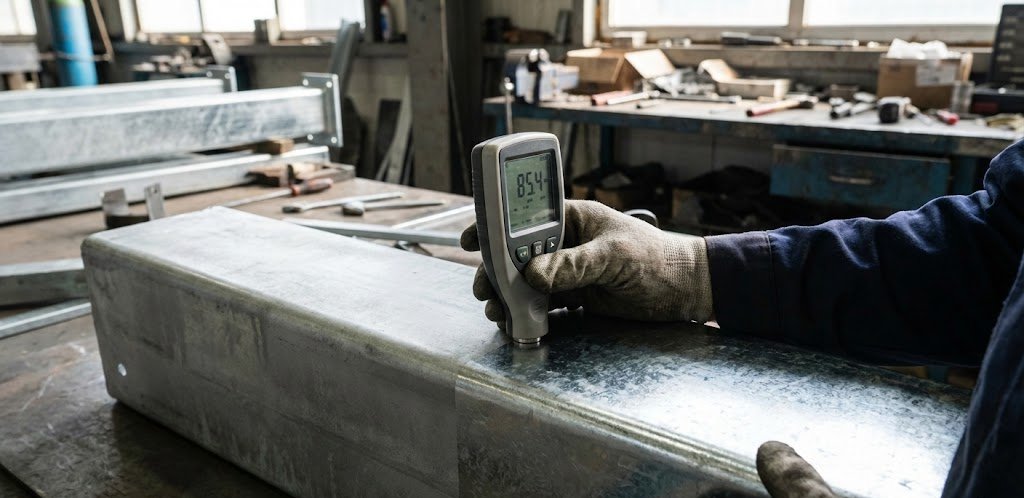
Coating Thickness Measurement
Portable magnetic coating thickness gauges can be used to measure remaining zinc thickness on suitable steel surfaces.
Measurements should be taken at representative locations rather than relying on a single reading.
Structural Assessment
Where corrosion has affected the steel itself, additional evaluation may be required to determine:
- Remaining steel thickness
- Section loss
- Cracking
- Deformation
- Connection condition
Coating renewal should not be used as a substitute for structural repair.
How Is Galvanized Coating Renewed?
The process depends on whether the component requires local repair or complete reprocessing.
1. Condition Assessment
The existing coating and underlying steel are inspected.
The assessment determines whether the component needs:
- Cleaning only
- Local zinc repair
- Paint repair
- Thermal spray repair
- Complete coating removal and re-galvanizing
- Structural repair or replacement
2. Surface Preparation
Damaged areas must be prepared before a repair coating is applied.
Depending on the selected repair method, preparation may include:
- Wire brushing
- Grinding
- Abrasive blasting
- Removal of corrosion products
- Removal of incompatible coatings
The required surface preparation should follow the repair coating manufacturer’s instructions and applicable technical specification.
3. Removal of the Existing Coating Where Necessary
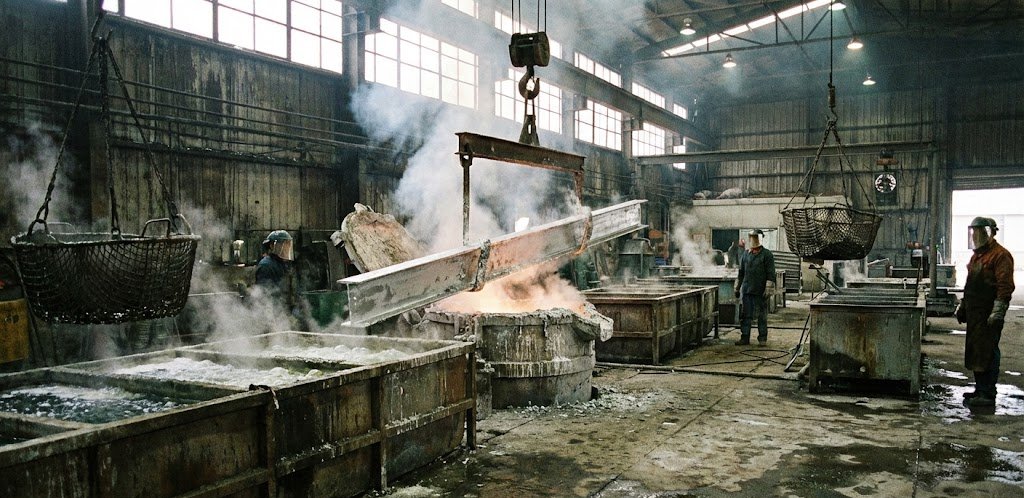
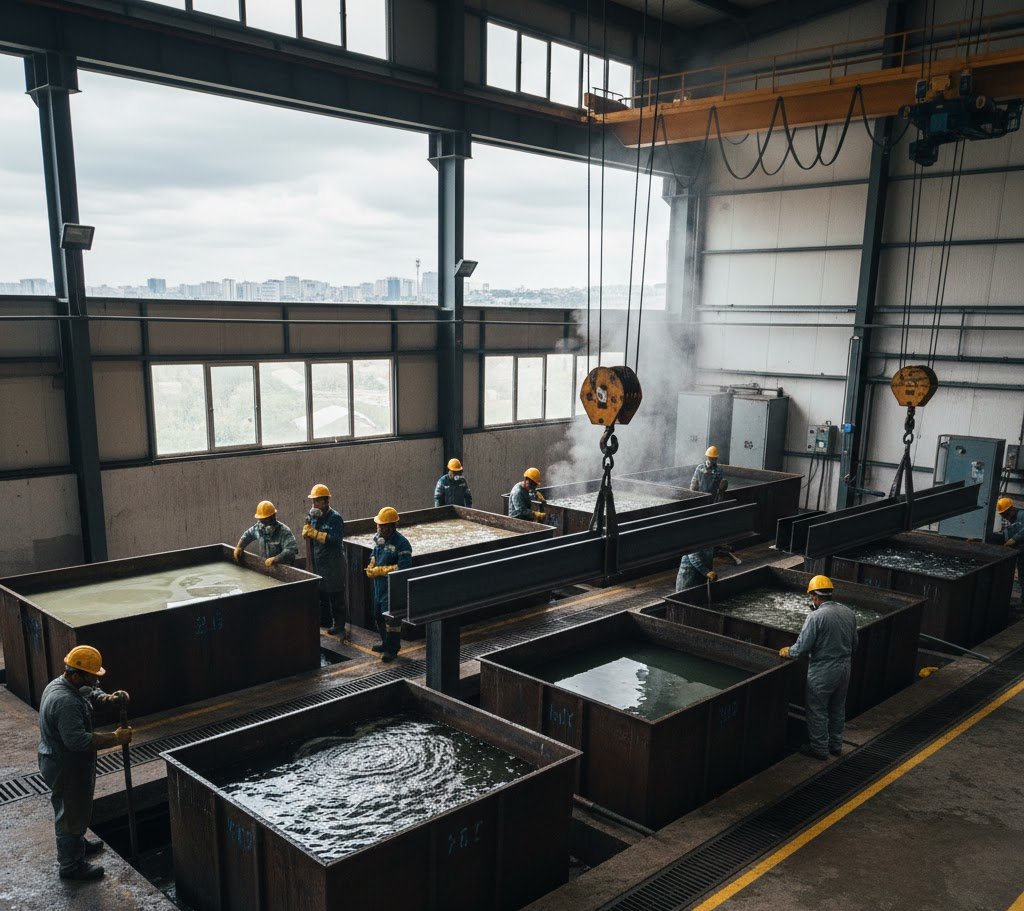
Complete re-galvanizing generally requires the existing zinc coating and corrosion products to be removed so that the steel can be properly prepared again.
This should be performed under controlled industrial conditions because stripping and chemical pretreatment can affect the steel and generate process wastes requiring proper management.
4. Re-Galvanizing or Local Repair
Several methods may be available.
Re-Galvanizing by Hot-Dip Galvanizing
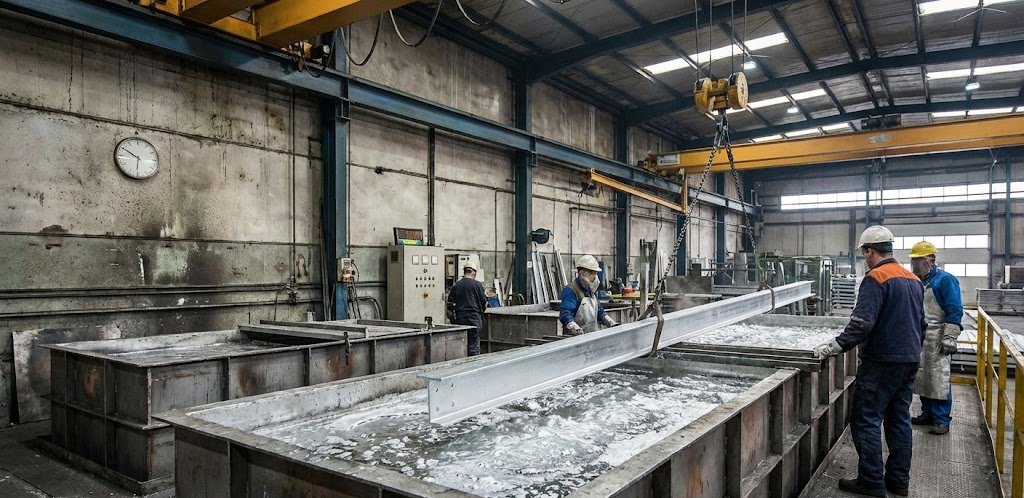
Where technically suitable, a fabricated steel component can be stripped, prepared, and hot-dip galvanized again.
During hot-dip galvanizing, properly prepared steel is immersed in molten zinc, commonly at approximately 450°C.
Re-galvanizing may provide comprehensive zinc protection, but several factors must be assessed first:
- Component dimensions
- Steel condition
- Existing distortion
- Fabrication details
- Hollow sections
- Venting and drainage
- Previous repairs
- Heat sensitivity
- Dimensional tolerances
Not every installed or previously galvanized component is suitable for complete re-galvanizing.
Zinc-Rich Repair Coatings
Zinc-rich paints are commonly used for localized repair and maintenance.
They can be practical for:
- Cut edges
- Welded areas
- Installation damage
- Small exposed steel areas
- Components that cannot be returned to a galvanizing plant
These coatings are not identical to hot-dip galvanizing and do not form the same metallurgically bonded zinc-iron layers.
Performance depends on surface preparation, dry film thickness, zinc content, binder chemistry, application quality, and environmental exposure.
Thermal Spray Zinc
Thermal spraying can apply zinc or zinc alloys to properly prepared steel surfaces.
It may be useful for:
- Large structures
- On-site rehabilitation
- Components that cannot be immersed
- Extensive repair areas
Abrasive blast preparation is typically important because adhesion depends strongly on the prepared surface.
Repair Methods Under Galvanizing Standards
For newly hot-dip galvanized fabricated steel, standards such as EN ISO 1461 define requirements for repair of certain uncoated or damaged areas within specified limits.
Repair methods can include suitable:
- Zinc-rich paint
- Zinc thermal spraying
- Zinc-based repair materials
The applicable standard and project specification should be consulted before selecting a repair method.
Cooling and Post-Treatment
For components that are completely re-galvanized, cooling and any post-treatment are managed according to the galvanizing plant’s process.
Passivation or other temporary protective treatments may be used where protection against wet-storage staining is required.
Post-treatment should not be confused with restoring structural strength or replacing zinc that has already been consumed in service.
Quality Control After Renewal
The inspection method depends on the repair system used.
For re-galvanized steel, inspection may include:
- Visual examination
- Coating thickness measurement
- Evaluation of coating continuity
- Inspection of repaired areas
- Dimensional checks where required
For paint or thermal spray repairs, additional requirements may include:
- Surface preparation verification
- Dry film thickness measurement
- Adhesion testing where specified
- Coverage inspection
The applicable acceptance criteria should be defined before work begins.
Applications of Galvanized Coating Renewal
Renewal and repair may be considered for:
- Structural steel
- Industrial platforms
- Railings
- Utility structures
- Transmission equipment
- Agricultural structures
- Highway infrastructure
- Steel roofs
- Fencing systems
- Outdoor support structures
- Industrial equipment
The correct maintenance method varies considerably between these applications.
Hot-Dip Re-Galvanizing vs. Zinc-Rich Repair Coatings
| Feature | Hot-Dip Re-Galvanizing | Zinc-Rich Repair Coating |
|---|---|---|
| Process | Re-immersion in molten zinc after preparation | Applied to prepared surface |
| Bonding | Metallurgical zinc-steel reaction | Coating adhesion to substrate |
| Typical use | Complete component renewal | Local repair and maintenance |
| Site application | Generally requires plant processing | Often possible on site |
| Component size limitation | Limited by plant and handling capacity | More flexible |
| Surface preparation | Industrial stripping and pretreatment | Depends on coating specification |
Neither method is universally preferable. Selection depends on component condition, repair area, accessibility, environment, and lifecycle requirements.
Can Renewal Extend Service Life?
Yes. Restoring an effective corrosion protection system can extend the remaining service life of steel when the underlying component is still structurally suitable.
However, the amount of additional service life cannot be expressed as a universal percentage or fixed number of years.
Performance depends on:
- Repair method
- Surface preparation
- Coating thickness
- Environmental exposure
- Steel condition
- Application quality
- Maintenance
A technically appropriate repair can delay further corrosion, but it cannot reverse existing steel section loss.
Maintenance Planning by Environment
Fixed renewal schedules such as “every five years” or “every ten years” are generally less reliable than condition-based maintenance.
A better approach is to establish inspection frequency according to:
- Environmental corrosivity
- Structural importance
- Accessibility
- Historical corrosion rate
- Mechanical exposure
- Consequences of failure
Coastal and industrial environments may require more frequent inspection than sheltered inland environments.
Avrasya Galvaniz and Coating Renewal Evaluation
Avrasya Galvaniz can evaluate hot-dip galvanizing requirements for fabricated steel components, including projects where previously galvanized components are being considered for reprocessing.
Technical evaluation may include:
- Existing coating condition
- Component dimensions
- Steel characteristics
- Product geometry
- Structural condition information
- Venting and drainage
- Stripping requirements
- Applicable coating standard
- Inspection requirements
- Logistics
Whether complete re-galvanizing is appropriate should be determined after reviewing the actual component.
Technical Considerations Before Renewal
Before starting a renewal project:
- Inspect the remaining zinc coating.
- Identify exposed steel and red rust.
- Measure representative coating thickness where useful.
- Evaluate steel section loss.
- Determine whether damage is local or widespread.
- Identify the operating environment.
- Select a compatible repair system.
- Confirm surface preparation requirements.
- Define quality acceptance criteria.
- Plan access, handling, transportation, and reinstallation.
Renewal Strategies for Different Applications
Outdoor Structural Steel
Condition-based inspection should focus on water traps, connections, damaged areas, and locations exposed to salts or pollutants.
A duplex system combining zinc protection with a compatible paint coating may be considered where additional corrosion protection is required.
Chemically Aggressive Environments
Zinc is not equally resistant to every chemical environment. In strongly acidic, alkaline, or specialized industrial conditions, a different protective coating system may be more appropriate.
Moving Components
Hinges, sliding surfaces, threads, and moving interfaces require special attention because coating thickness can affect tolerances and movement.
A coating suitable for static structural steel may not automatically be suitable for a precision moving surface.
Long-Term Protection Requires Condition-Based Decisions
Galvanized coating renewal is most effective when it is based on actual coating condition rather than fixed time intervals.
Localized damage may require only a suitable repair coating, while extensive coating loss may justify complete stripping and re-galvanizing. If corrosion has already reduced the structural integrity of the steel, repair or replacement of the steel itself may be necessary before any new coating is applied.
For components being considered for hot-dip re-galvanizing, Avrasya Galvaniz can evaluate dimensions, existing condition, technical requirements, and project specifications to help determine an appropriate corrosion protection approach.